
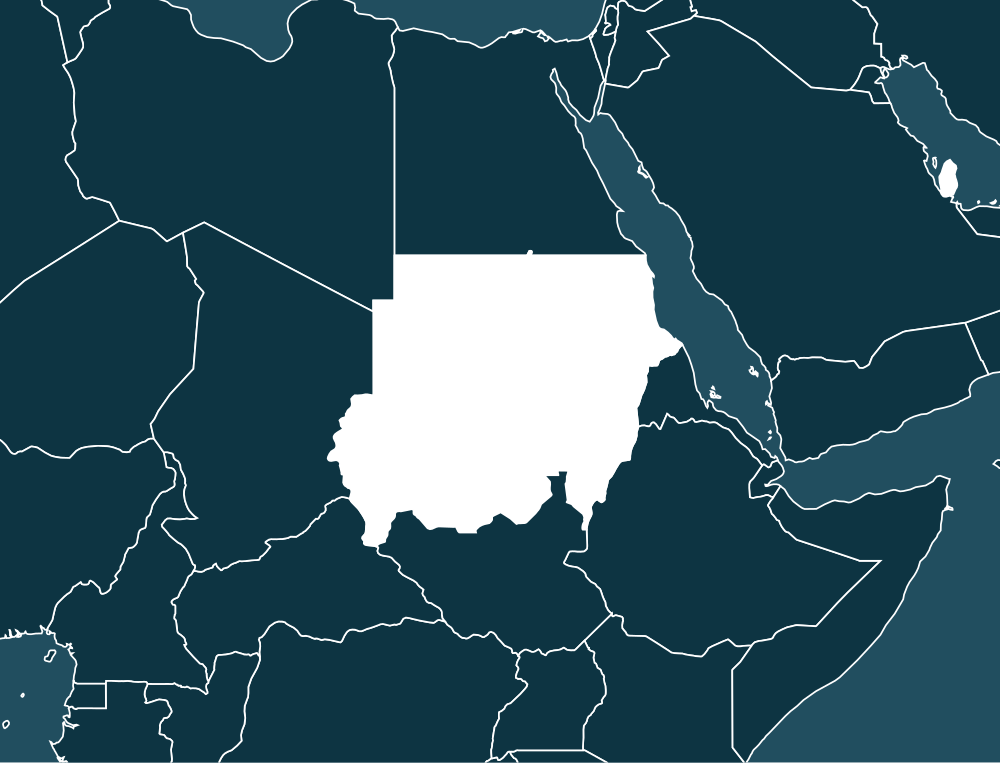
Risk Indicators
- FATF/EU Blacklist/Greylist (Lower Concern)
- Terrorism Financing (Medium Concern)
- US Dept of State INCSR
- Proliferation Financing
- Corruption
- Criminality
- Resilience & Governance
- Financial Transparency
- Offshore Finance Centres
- Sanctions
Background
Sudan’s history extends from the Kingdom of Kerma and Kush through Christian Nubian kingdoms, Arab settlement, and the period of effective British colonial rule under Anglo-Egyptian administration. Since independence in 1956, political life has been shaped by military rule, Islamic-oriented governments, and prolonged north–south conflict, culminating in South Sudan’s independence in 2011 while leaving unresolved security and economic arrangements. Conflict has also persisted in Darfur, Southern Kordofan, and Blue Nile, alongside a turbulent transition following the removal of Omar Hassan Ahmad al-BASHIR and the later rise of General Abd-al-Fatah al-BURHAN.
Sudan’s current instability extends well beyond its borders, affecting refugee flows, armed-group movements, and contested supply routes across a region already marked by political and security crises. South Sudan, Chad, the Central African Republic, Ethiopia, Eritrea, Libya, and Egypt each feature distinct connections to the conflict, ranging from RSF-linked activity and SAF support to wider concerns involving arms trafficking and potential sanctions evasion. These regional dynamics have drawn attention to UN arms embargoes, cross-border networks, and the difficulty of containing conflict financing amid overlapping humanitarian and security pressures.
AML & Terrorist Financing
Sudan has strengthened its AML/CFT framework and, following FATF’s 23 October 2015 statement, exited enhanced monitoring, yet important effectiveness and implementation gaps remain. The Sudan FIU, CBOS, and other bodies have expanded supervision and reporting, but low suspicious-transaction reporting, limited investigative capacity, incomplete risk-based inspections, and the absence of meaningful money-laundering or terrorist-financing convictions continue to attract attention. Cash-based commerce, trade-based laundering, corruption, sanctions-related isolation, vulnerable borders, and weaknesses affecting correspondent banking relationships further complicate efforts that include beneficial-ownership reforms and the freezing of terrorist assets.
Sanctions
Sudan is subject to a broad and increasingly coordinated sanctions framework, centered on the UN Darfur arms embargo and expanded measures by OFAC, the European Union, the United Kingdom, Canada, and other jurisdictions. Restrictions include arms controls, asset freezes, travel bans, and financial and export limitations, with recent designations reaching senior RSF and SAF figures such as Hemedti, Abdel Fattah Al-Burhan, and Osman Mohamed Hamid Mohamed. No autonomous sanctions imposed by Sudan on other nations are identified, while concerns instead focus on evasion through military-linked enterprises, opaque ownership structures, gold routes, and financial networks spanning neighboring and international markets.
Criminality
Corruption is widespread across Sudan’s public institutions, with weak enforcement, ineffective financial-disclosure oversight, and the post-2021 abolition of the anti-corruption commission complicating accountability; even high-profile proceedings involving Omar Bashir offer only limited indication of broader institutional control. Sudan is also a major hub for human trafficking and smuggling, while gold smuggling, arms and drug trafficking, financial fraud, and illicit activity linked to actors such as the Rapid Support Forces contribute to a deeply entrenched criminal economy.
Reports
Sudan’s prolonged conflict has deepened vulnerabilities to trafficking, including child soldier recruitment, sexual slavery, forced labor, and exploitation of displaced people, while the National Committee to Combat Human Trafficking has taken limited steps amid inadequate victim protections. At the same time, fighting has weakened the General Intelligence Service and border controls, leaving parts of the country vulnerable to extremist facilitation and illicit movement even as Sudan recorded no terrorist incidents in 2024.
Economy & Investment Climate
Sudan’s economy combines substantial opportunities in gold, oil, agriculture, and infrastructure with severe disruption from political instability, conflict, currency depreciation, shortages, and limited access to foreign exchange. While the Ministry of Investment and International Cooperation offers incentives and the Central Bank of Sudan has pursued monetary reforms, military-linked enterprises, weak institutions, corruption, and uncertain implementation continue to complicate investment and broader economic recovery.
Cryptocurrency Regulations
Sudan’s cryptocurrency landscape remains marked by caution and uncertainty, with the Central Bank of Sudan (CBOS) rejecting digital assets as money or private property while the Anti-Money Laundering and Combating the Financing of Terrorism Act of 2014 provides only broad financial-crime controls. Although crypto activity is not expressly banned, the absence of VASP licensing, crypto-specific transaction rules, token and ICO oversight, and dedicated tax-tracking mechanisms leaves users and businesses navigating an ambiguous environment shaped largely by general banking and income-tax provisions.
Get full access
The information on this page is a brief summary. Get access to EDD country reports, all risk category scores and customisable weightings for 245 jurisdictions.