
Risk Indicators
- FATF/EU Blacklist/Greylist (Higher Concern)
- Terrorism Financing (Higher Concern)
- US Dept of State INCSR
- Proliferation Financing
- Corruption
- Criminality
- Resilience & Governance
- Financial Transparency
- Offshore Finance Centres
- Sanctions
Background
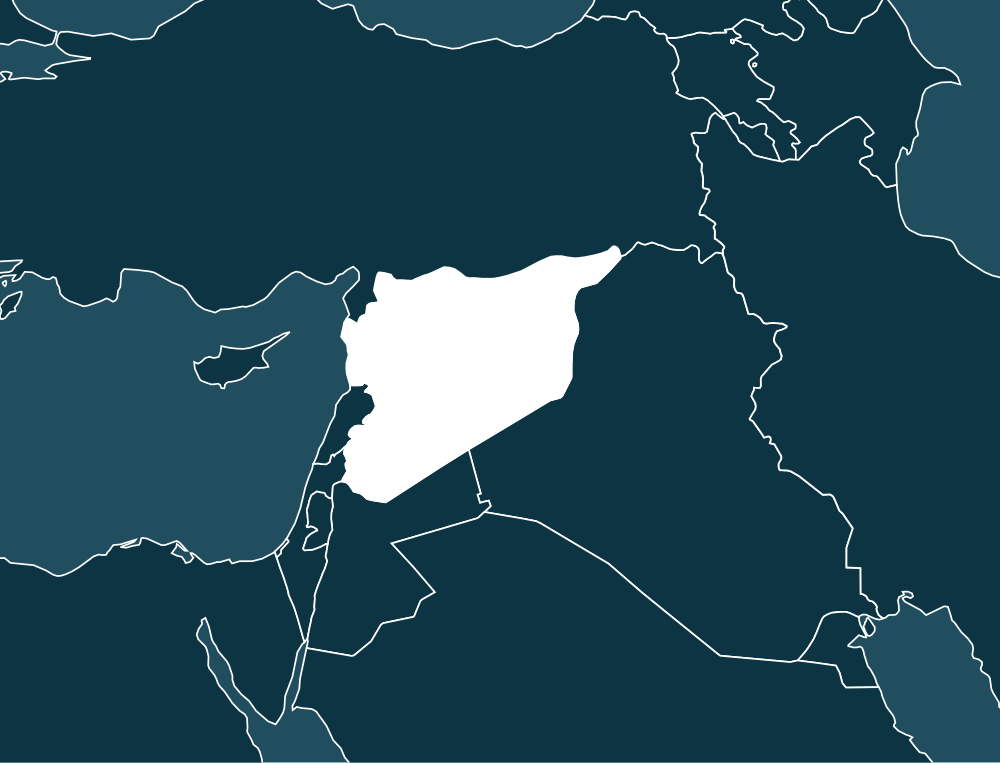
Syria emerged from the French mandate in 1946 amid repeated coups, later experiencing union with Egypt, the loss of the Golan Heights, and decades of rule by Hafiz al-ASAD and Bashar al-ASAD. The 2011 uprising in Dar'a developed into a protracted civil war shaped by domestic repression, opposition movements, foreign intervention, and pressure from the Arab League, EU, Turkey, and the United States. By December 2024, Islamist rebels had captured Damascus, ending more than five decades of al-ASAD family rule as the former president sought asylum in Moscow.
The conflict has left Syria divided among government, Kurdish-led Syrian Democratic Forces, Turkish-backed groups, and Hay’at Tahrir al-Sham, while creating one of the world’s largest displacement crises. Neighbouring states remain deeply entangled through cross-border operations, militia activity, refugee pressures, airstrikes, and networks involving entities such as Hezbollah, al-Haram Exchange, and Turkish-linked commercial actors. Porous borders, contested territory, sanctions evasion routes, and demands surrounding the demilitarisation of southern Syria continue to connect the country’s security and political challenges to those of Türkiye, Iraq, Jordan, Lebanon, and Israel.
AML & Terrorist Financing
Syria remains subject to strategic AML/CFT concerns, with conflict, sanctions, cash-based commerce, hawala networks, porous borders, and illicit activity linked to narcotics, arms, and terrorist financing complicating oversight. Although the Combating Money Laundering and Terrorism Financing Commission, Central Bank of Syria, and judicial authorities provide a formal institutional framework, FATF has not been able to verify sustained implementation through an onsite visit, while enforcement capacity and political commitment remain uncertain. Further areas of concern include the sanctioned Commercial Bank of Syria, limited suspicious transaction reporting, weak beneficial-ownership transparency, and the evolving role of actors such as ISIS, Hizballah-linked networks, and the Qatirji Company.
Sanctions
Syria is primarily the target of a layered sanctions framework rather than an identified enforcer of sanctions against other nations, with UN measures, OFAC restrictions, EU and UK controls, and parallel regimes from Australia, Canada, Japan, and others affecting arms, finance, trade, travel, and designated individuals. While several economic restrictions were eased or suspended in 2025—including measures reflected in OFAC General License 25 and European and UK amendments—core designations, defense-related controls, and counter-terrorism restrictions remain significant. The continuing relevance of Resolution 1636, the 1267 regime, the Caesar Act, and Arab League measures is further complicated by evasion channels involving shell companies, hawala networks, Lebanon, Dubai, Turkish ports, and actors linked to Russia, Iran, and Hezbollah.
Criminality
Syria faces pervasive criminal activity across human trafficking, arms and counterfeit goods, fuel smuggling, illicit finance, and drug markets, with Captagon production particularly prominent and Hezbollah among the foreign actors involved. Corruption, bribery, nepotism, tax evasion, and embezzlement are widespread, while state-linked and private-sector networks often overlap with organized crime in ways that blur the boundaries between official and illicit activity.
Reports
Syria remains under scrutiny from the IAEA and U.S. State Department over unresolved questions surrounding the undeclared al-Kibar reactor and possible nuclear material, while Captagon trafficking networks linked to regime-associated actors continue to affect regional security. Assessments from the U.S. State Department also describe extensive trafficking vulnerabilities involving forced labor, sexual exploitation, and child soldiers amid displacement and conflict, alongside Assad-era support for Hizballah, Iran-linked forces, and other terrorist organizations.
Economy & Investment Climate
Syria’s economy remains deeply weakened by prolonged conflict, with GDP down 84% from 2010, a sharply depreciated Syrian pound, and agriculture—particularly wheat, olives, and livestock—still playing an outsized role amid poverty, food insecurity, and damaged infrastructure. Sanctions and instability continue to constrain investment and trade, even as exports such as olive oil and phosphates move toward markets including Turkey and Saudi Arabia and authorities consider longer-term opportunities in tourism and natural gas.
Cryptocurrency Regulations
Syria’s cryptocurrency landscape remains largely undefined: Legislative Decree No. 33 of 2005 supports the CCMLFT’s broader AML mandate, while the Central Bank of Syria has not established dedicated rules, licensing, or recognition for digital assets. With Syria under FATF increased monitoring and no clear crypto tax, exchange, token-offering, or Travel Rule framework, businesses and users face substantial uncertainty and heightened compliance risks.
Get full access
The information on this page is a brief summary. Get access to EDD country reports, all risk category scores and customisable weightings for 245 jurisdictions.