
Risk Indicators
- FATF/EU Blacklist/Greylist (Lower Concern)
- Terrorism Financing (Medium Concern)
- US Dept of State INCSR
- Proliferation Financing
- Corruption
- Criminality
- Resilience & Governance
- Financial Transparency
- Offshore Finance Centres
- Sanctions
Background
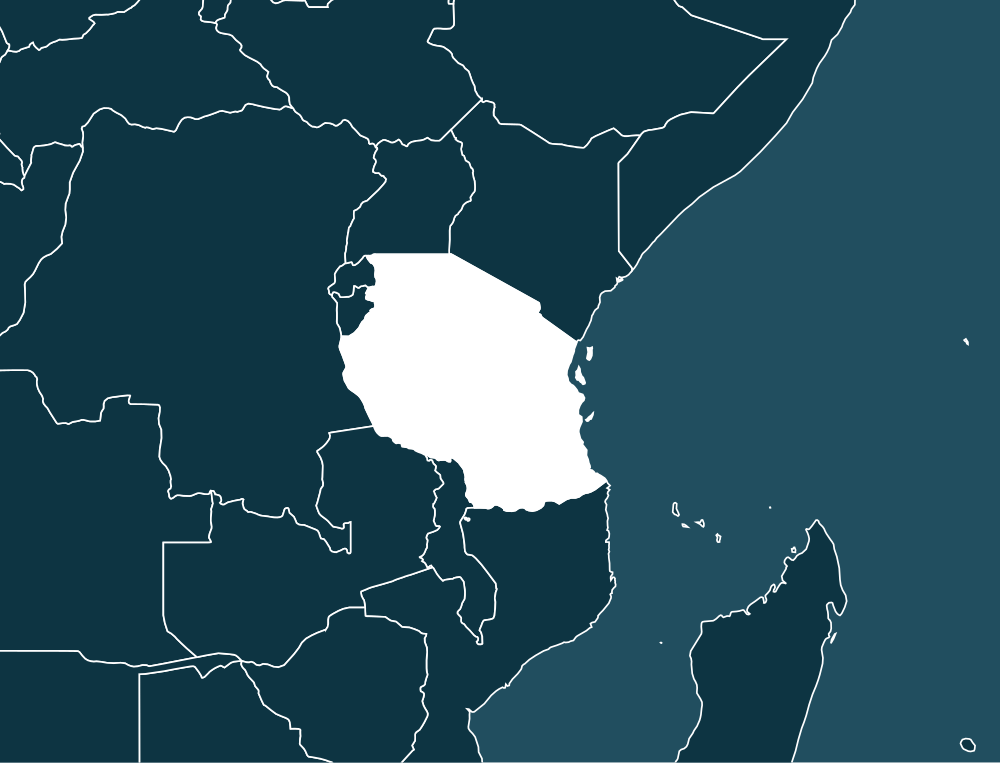
Tanzania’s identity has been shaped by its distinctive blend of coastal, island, and mainland histories, reflected in Swahili, Islam, and a diverse ethnolinguistic population. From Portuguese and Omani influence to German and British administration, the region’s position in Indian Ocean trade left enduring political and cultural legacies, including Zanzibar’s pivotal role. The union of Tanganyika and Zanzibar in 1964 created a state in which Zanzibar retained considerable autonomy, while Chama Cha Mapinduzi has remained the dominant political force since the first multiparty elections in 1995.
Today, Tanzania’s strategic position places it amid regional pressures involving the M23 rebellion in the Democratic Republic of Congo, refugee movements around Burundi, and security concerns linked to AASWJ near Mtwara. Its relationships with Malawi and South Africa have also been affected by reciprocal agricultural restrictions and disputes over transit and market access, including the importance of Dar es Salaam Port to Malawi. Military patrols, trade measures, and regional diplomacy remain central to Tanzania’s response, even as tensions among SADC and EAC partners present wider implications for security and integration.
AML & Terrorist Financing
Tanzania has made significant AML/CFT progress and, as of June 2025, is no longer subject to FATF increased monitoring, although ESAAMLG follow-up continues. Persistent concerns include uneven risk-based supervision, limited use of FIU intelligence, modest money-laundering prosecution and conviction outcomes, and vulnerabilities linked to cash activity, construction, mining, real estate, ports, tourism, and Zanzibar-based operations. Terrorist-financing and proliferation-financing controls remain areas of particular sensitivity, involving risk assessment, targeted financial sanctions, NPO oversight, beneficial ownership transparency through BRELA, and coordination among agencies such as the FIU, Bank of Tanzania, PCCB, CID, and DPP.
Sanctions
Tanzania is obligated to implement UN Security Council sanctions, including measures such as arms restrictions, travel bans, and financial controls, but no international sanctions are currently in force against Tanzania itself. Its maritime and trade networks have nevertheless been associated with alleged evasion involving Iranian-linked tankers, North Korean-linked vessels, and shadow-fleet shipments of sanctioned Russian oil. Practices reportedly include false flagging, ship-to-ship transfers, and manipulated invoices along the Indian Ocean Corridor, East African coast, and SADC/EAC trade zones, raising concerns about port oversight and registry controls.
Criminality
Tanzania faces persistent corruption concerns despite formal safeguards, electronic-service reforms at institutions such as the Tanzania Revenue Authority, BRELA, and the Tanzania Port Authority, and dedicated bodies including the PCCB, Ethics Secretariat, and ZAECA. Illicit activity spans trafficking and smuggling, counterfeit and excise goods, illegal logging, wildlife and mineral crime, regional drug markets, rising cybercrime, and financial offenses linked to procurement, customs, and private-sector dealings, with NGOs and media citing difficulties investigating corruption and a culture of impunity.
Reports
Tanzania’s security landscape includes expanding drug transit and destination activity, with the DCEA and Zanzibar’s ZDCEA recording major seizures, asset forfeitures, precursor-chemical interceptions, and broader treatment initiatives. At the same time, trafficking vulnerabilities span domestic exploitation, Zanzibar-linked migration routes, and refugee communities, while ISIS recruitment and cross-border activity continue despite no terrorist attacks recorded in 2024.
Industry/Product Sector Risk
Tanzania’s financial and broader commercial landscape presents a varied AML/CFT risk profile, with banking, real estate, mining, trade finance, telecommunications, transportation, hospitality and cash-intensive activities standing out amid widespread informal and cash-based transactions. Oversight is distributed among bodies including the Bank of Tanzania, Gaming Board of Tanzania, Tanzania Insurance Regulatory Authority and Capital Markets and Securities Authority, although gaps in risk-based supervision, beneficial ownership transparency, licensing and suspicious transaction reporting remain evident across several sectors. Exposure is closely linked to corruption, tax evasion, illegal mining and precious-stone trading, wildlife crime, smuggling and drug trafficking, with mobile money, cross-border commerce, property, high-value goods and informal value-transfer channels offering particularly important areas for deeper analysis.
Economy & Investment Climate
Tanzania’s economy combines a large agricultural base with expanding industry, mining, services, and trade links spanning India, the UAE, China, and regional partners, supported by rising exports and growing private-sector credit. Although the government actively promotes investment through the Tanzania Investment Centre and Zanzibar Investment Promotion Agency, investors continue to encounter uneven tax treatment by the Tanzania Revenue Authority, regulatory uncertainty, local-content and labor constraints, and lengthy administrative processes.
Cryptocurrency Regulations
Tanzania’s cryptocurrency landscape remains cautious and unsettled: the Bank of Tanzania recognizes only the Tanzanian Shilling as legal tender, while the Finance Act 2024 introduced a 3% withholding tax on digital-asset transfers without creating a complete virtual-asset regime. Oversight is distributed among the Bank of Tanzania, Financial Intelligence Unit, Tanzania Revenue Authority, and potentially the Capital Markets and Securities Authority, leaving exchanges, token offerings, travel-rule obligations, and investor protections subject to significant regulatory gaps.
Get full access
The information on this page is a brief summary. Get access to EDD country reports, all risk category scores and customisable weightings for 245 jurisdictions.