
Risk Indicators
- FATF/EU Blacklist/Greylist (Lower Concern)
- Terrorism Financing (Medium Concern)
- US Dept of State INCSR
- Proliferation Financing
- Corruption
- Criminality
- Resilience & Governance
- Financial Transparency
- Offshore Finance Centres
- Sanctions
Background
Timor-Leste’s modern identity reflects centuries of trade, Portuguese and Dutch colonial involvement, Japanese occupation, and a traumatic struggle involving Indonesia. Following the 1999 UN-supervised referendum, widespread destruction and displacement preceded international recognition of independence in 2002, with Australian-led peacekeepers playing a decisive role. Since then, elections and democratic institutions have strengthened, although fragile coalitions, economic dependence on Timor Sea energy resources, and continuing UN assistance remain important features of the country’s development.
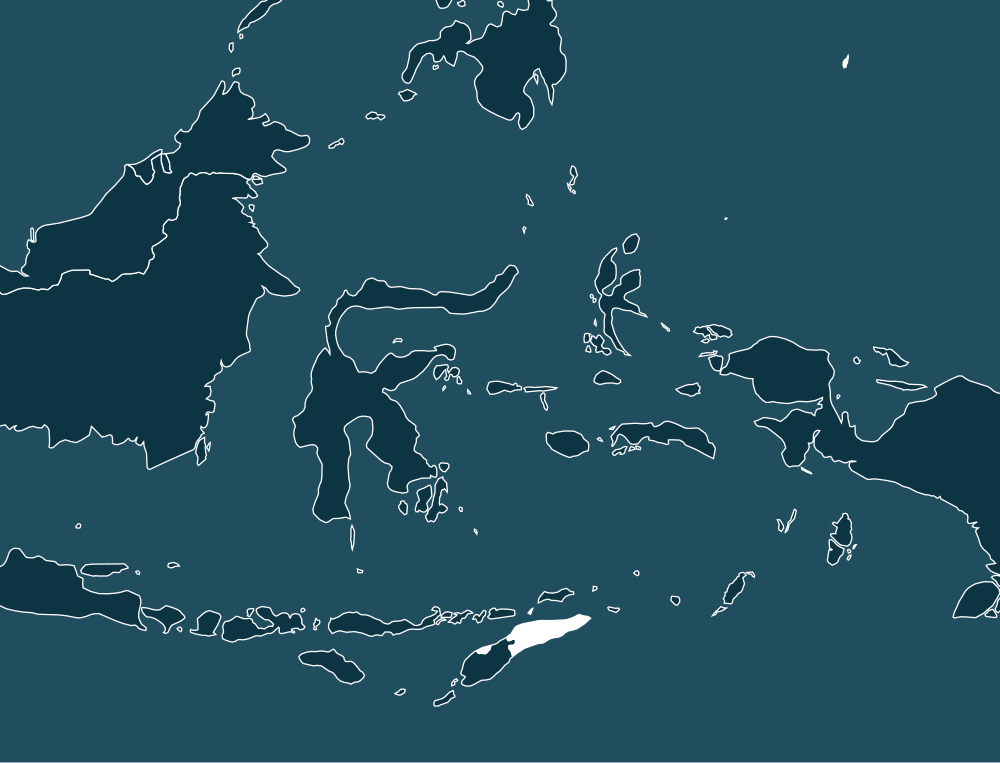
Sharing its only land border with Indonesia—including around the Oecussi enclave—Timor-Leste continues to navigate border security, trafficking, migration, and the unresolved sensitivities of the occupation period. Australia remains a vital defence and stability partner, while China’s infrastructure and security engagement has added a broader strategic dimension involving Jakarta and Canberra. Timor-Leste applies UN sanctions rather than maintaining an autonomous regime, and although Southeast Asia faces wider maritime-smuggling and North Korean procurement risks, no major evasion activity is specifically attributed to the country.
AML & Terrorist Financing
Timor-Leste is not on the FATF list of jurisdictions with strategic AML deficiencies, but its cash-based economy, porous borders, corruption exposure, and limited risk assessments continue to create vulnerabilities involving tax evasion, drug trafficking, cash smuggling, and other proceeds-generating crimes. Although the CNCBC, UIF, Banco Central de Timor-Leste, PCIC, PNTL, PGO, and CAC provide an institutional framework, effectiveness is constrained by uneven supervision, inconsistent STR reporting, limited financial intelligence and asset recovery, gaps in beneficial ownership transparency, and underregulated DNFBPs and microfinance. Terrorist financing activity has not been identified or prosecuted, yet limited understanding of TF risk, delayed or incomplete targeted financial sanctions, the absence of a proliferation-financing framework, and unassessed NPO vulnerabilities leave important preventive gaps.
Sanctions
Timor-Leste supports United Nations sanctions adopted under Article 41 of the UN Charter, including measures such as arms embargoes, travel restrictions, and financial or commodity controls. Implementation is linked to the Security Council’s Consolidated List and its sanctions committees, covering regimes addressing issues such as political conflict, nuclear non-proliferation, and counter-terrorism. As of mid-2026, no international sanctions were in force against Timor-Leste.
Criminality
Timor-Leste faces persistent corruption risks, including alleged embezzlement, procurement concerns, tax evasion, and misuse of public funds, although the Anti-Corruption Commission has referred cases for investigation and secured convictions in notable procurement matters. Crime also includes trafficking through porous borders, tobacco and counterfeit-goods smuggling, business-focused extortion by martial arts groups, and suspected links between officials, criminal networks, and money laundering, while enforcement has been complicated by limited resources and the temporary suspension of CAC operations.
Reports
Timor-Leste remains a potential transit point for methamphetamine and other illicit activity, with the PCIC, PNTL Border Police Unit, and Customs Directorate facing gaps in training, equipment, data, and investigative capacity despite growing cooperation with Indonesia and international partners. Trafficking vulnerabilities extend from rural communities and domestic work to foreign workers and overseas recruitment schemes, while KLATU has identified more victims and increased investigations but continues to face resource constraints, limited specialized services, and no prosecutions or convictions for a third consecutive year.
Industry/Product Sector Risk
Timor-Leste’s financial and wider commercial landscape is shaped by a small, cash-based economy in which banks, money transfer operators, public infrastructure, petroleum-related activity, and cross-border trade present differing levels of exposure. Particular attention surrounds corruption, tax evasion, smuggling, fraud, and beneficial-ownership weaknesses, alongside developing oversight of e-wallets, informal professional services, property transactions, and non-bank lenders. The roles of BCTL, SERVE I.P., the Ministry of Justice, the Anti-Corruption Commission, and the Petroleum Fund provide important context for understanding where controls are established, where supervision remains limited, and how emerging risks may evolve.
Economy & Investment Climate
Timor-Leste is a peaceful, politically competitive democracy whose economy remains closely tied to public spending and the Petroleum Fund as oil and gas production declines, while agriculture, coffee, tourism, and other non-oil activities offer avenues for diversification. Foreign investment is welcomed through agencies such as TradeInvest Timor-Leste, SERVE, and ANPM, but investors continue to encounter infrastructure gaps, limited skills, land-title disputes, bureaucratic delays, and evolving legal institutions as the country works toward ASEAN and WTO-aligned reforms.
Cryptocurrency Regulations
Timor-Leste’s cryptocurrency landscape remains largely undefined: the U.S. dollar is the only legal tender under Decree-Law No. 20/2003, while Law No. 17/2011 provides broader AML obligations without a dedicated virtual-asset regime. The June 2024 FATF/APG Mutual Evaluation and the position of Banco Central de Timor-Leste point to no registered VASPs, specific exchange or token-offering rules, Travel Rule implementation, or dedicated crypto-tax tracking—leaving substantial questions around oversight, compliance, and investor protection.
Get full access
The information on this page is a brief summary. Get access to EDD country reports, all risk category scores and customisable weightings for 245 jurisdictions.