
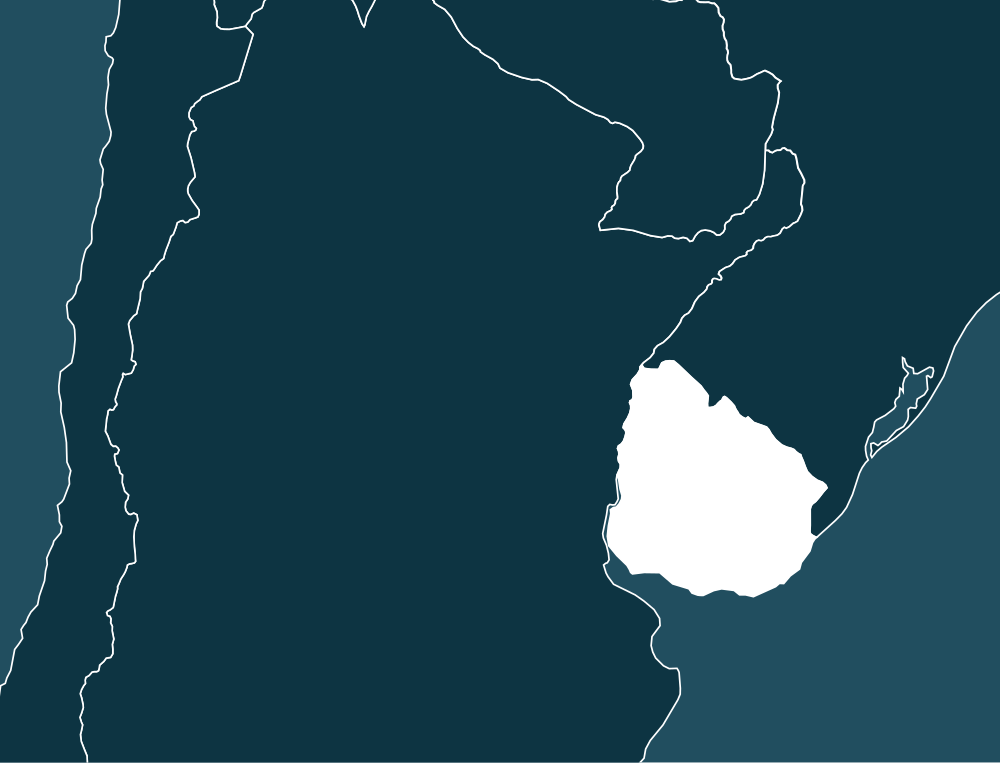
Risk Indicators
- FATF/EU Blacklist/Greylist (Lower Concern)
- Terrorism Financing (Lower Concern)
- US Dept of State INCSR
- Proliferation Financing
- Corruption
- Criminality
- Resilience & Governance
- Financial Transparency
- Offshore Finance Centres
- Sanctions
Background
Founded as a Spanish military stronghold in 1726, Montevideo developed into a commercial center whose harbor helped shape Uruguay’s strategic importance. Independence followed conflict involving Argentina and Brazil, while the reforms of José Batlle established a lasting statist tradition before military rule and the Tupamaros insurgency marked a more turbulent period. Civilian government returned in 1985, and the Frente Amplio’s 2004 victory ended the long dominance of the Colorado and National parties.
Today, Uruguay combines comparatively free political and labor conditions with exposure to regional pressures involving Argentina and Brazil. Mercosur disagreements, disputes over waterways, porous borders, and cross-border trafficking create challenges that intersect with Uruguay’s ports, dollarized economy, and financial system. Although it follows UN sanctions, the absence of autonomous sanctions lists and concerns over money laundering and organized crime add complexity to its regional balancing act.
AML & Terrorist Financing
Uruguay is not listed by FATF as having strategic AML deficiencies, yet its 2019 assessment found broad compliance alongside medium effectiveness across the assessed outcomes. Its principal exposure involves foreign criminal proceeds, particularly from neighbouring countries, with vulnerabilities noted in real estate, construction, corporate services, free trade zones, and certain non-financial professions, while the UIAF, SENACLAFT, and BCU continue strengthening supervision and financial intelligence. Terrorist-financing risk is considered low and the framework has been recently reinforced, but the absence of prosecutions, uneven DNFBP understanding of sanctions obligations, limited proactive financial investigations, and challenges surrounding beneficial-owner information leave important questions for closer review.
Sanctions
As a United Nations member, Uruguay supports Security Council sanctions, including measures reflected on the Consolidated List and covering areas such as arms, travel, finance, and commodities. No international sanctions are currently in force against Uruguay itself. However, its financial sector, gold trade, and role in regional transshipment corridors have raised concerns about evasion networks connected to Russia and Venezuela, alongside reported Russian intelligence activity and AML vulnerabilities.
Criminality
Uruguay is generally viewed as having relatively low levels of corruption, supported by anti-bribery and anti-money-laundering laws, although the Transparency and Public Ethics Board (JUTEP) remains comparatively low-profile and resource-constrained. Crime includes trafficking, cocaine transit, illicit cannabis activity, arms and goods smuggling, cyberattacks, and financial fraud, with small, localized criminal networks involved in some markets.
Reports
Uruguay’s strategic location, porous borders, and international ports expose it to cocaine transit despite relatively low drug-related corruption, while its regulated marijuana market and National Anti-Drug Secretariat reflect a distinctive approach to drug control and demand reduction. Human trafficking concerns span sex trafficking and forced labor affecting migrants, foreign workers, and fishing crews, with Uruguay upgraded to Tier 2 after expanded convictions and victim services but continuing to face shortcomings in screening, referral guidance, and support.
Industry/Product Sector Risk
Uruguay’s AML/CFT risk landscape is shaped by its role as a regional financial centre, with heightened exposure in banking, wealth management, real estate, construction, casinos, and professional services serving non-resident clients. Supervision and sectoral analysis by SENACLAFT, the SSF, and the UIAF point to recurring vulnerabilities involving cash, cross-border flows, beneficial ownership, corporate vehicles, and the varying maturity of customer monitoring outside the banking sector. At the same time, financial inclusion, electronic payments, free-zone trade, remittance activity, and emerging oversight of non-profit organisations create a broader mix of mitigated and evolving risks linked to tax crime, corruption, fraud, smuggling, drug trafficking, and potential terrorist financing.
Economy & Investment Climate
Uruguay offers a stable, transparent, and broadly open investment environment, supported by investment-grade ratings, strong institutions, free capital transfers, and regional access through Mercosur, free trade zones, and free ports. Its services-led economy is complemented by agribusiness, forestry, pulp, logistics, tourism, and a growing IT sector, while investors still navigate a small domestic market, relatively high operating costs, bureaucracy, labor constraints, and the significant role of state-owned enterprises.
Cryptocurrency Regulations
Uruguay is moving cryptocurrencies from a largely undefined space into a supervised framework shaped by Law No. 20,345, with the Central Bank of Uruguay (BCU) and SENACLAFT overseeing VASPs, exchanges, and evolving token classifications. Digital assets are not legal tender or prohibited, but operators face authorization, AML, KYC, reporting, and taxation requirements, while details such as the Travel Rule, ICO disclosures, and treatment of newer asset types continue to develop.
Get full access
The information on this page is a brief summary. Get access to EDD country reports, all risk category scores and customisable weightings for 245 jurisdictions.