
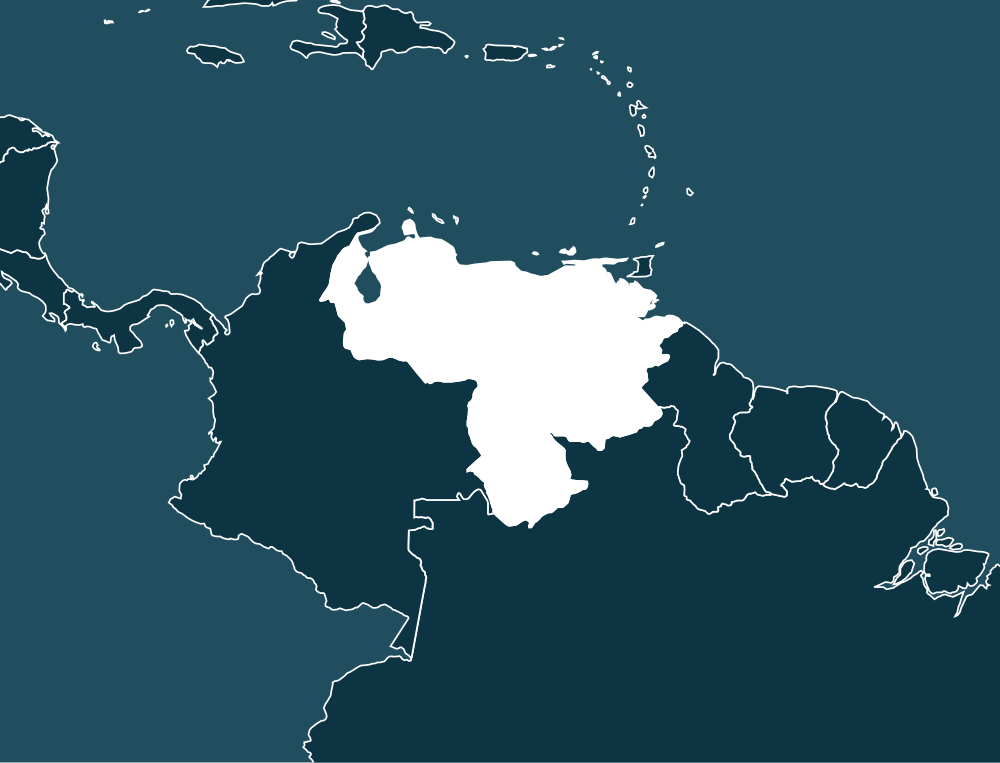
Risk Indicators
- FATF/EU Blacklist/Greylist (Higher Concern)
- Terrorism Financing (Medium Concern)
- US Dept of State INCSR
- Proliferation Financing
- Corruption
- Criminality
- Resilience & Governance
- Financial Transparency
- Offshore Finance Centres
- Sanctions
Background
Venezuela emerged from the dissolution of Gran Colombia in 1830 and spent much of its modern history balancing military rule, oil wealth, and limited social reform. Under Hugo Chávez and Nicolás Maduro, executive power expanded as elections, the National Assembly, courts, and media became subjects of sustained domestic and international scrutiny. Recent political developments, including opposition participation in 2021 elections observed by the EU and Maduro’s reported removal and arrest in 2026, have not resolved the country’s struggle over legitimacy and institutional independence.
Economic controls, petroleum dependence, sanctions, and chronic mismanagement have contributed to shortages, inflation, weakened infrastructure, and the departure of millions of Venezuelans. Human rights organizations continue to identify concerns involving politicized courts, security and intelligence agencies, violent crime, corruption, and laws used to suppress dissent. Beyond its borders, Venezuela’s difficulties intersect with Colombian armed-group violence, the Essequibo dispute with Guyana, refugee pressures in the Dutch Caribbean, and sanctions-evasion networks involving oil, gold, Russia, China, and Iran, while the ICJ and regional governments remain engaged.
AML & Terrorist Financing
Venezuela remains subject to strategic AML/CFT concerns, reflected in its FATF status and addition to the European Commission’s high-risk jurisdictions list, amid exposure to corruption, drug trafficking, illegal mining, smuggling, cash activity, and cross-border crime. The 2023 mutual evaluation identified broad weaknesses in risk understanding, supervision, beneficial ownership transparency, financial intelligence, investigations, confiscation, and international cooperation, with the UNIF’s paper-based reporting arrangements and the Attorney General’s Office’s central coordinating role highlighting operational challenges. Terrorist-financing and proliferation-financing controls remain particularly vulnerable, including shortcomings involving targeted financial sanctions and oversight of nonprofit organisations under the November 2024 NPO law, while the roles of bodies such as SUDEBAN, ONCDOFT, and SUNACRIP warrant close attention.
Sanctions
The material identifies no Venezuelan sanctions imposed on other nations, while noting that Venezuela has no United Nations Security Council sanctions against it. International restrictions instead include OFAC blocking measures involving the Venezuelan government, PdVSA, and more than 200 SDN-listed individuals and entities, alongside sectoral limits affecting energy, gold, mining, banking, and access to U.S. financial markets. Comparable targeted measures from the European Union, United Kingdom, Canada, and Switzerland include arms controls, asset freezes, travel restrictions, and financial prohibitions, against a backdrop of alleged evasion networks involving Russia, China, Iran, and regional intermediaries.
Criminality
Venezuela’s comprehensive anti-corruption laws are undermined by weak and inconsistent enforcement, with allegations involving public procurement, foreign-exchange authorizations, customs, taxation, and officials connected to PDVSA, alongside concerns about politically selective investigations and pressure on watchdogs. Criminal activity spans trafficking, extortion, arms and counterfeit-goods markets, illicit gold and oil flows, drug trafficking, cybercrime, and expanding online fraud, while megabandas exert territorial control and reporting or victim-support channels include the Public Ministry and Transparencia Venezuela.
Reports
Venezuela is portrayed as a major cocaine transit corridor increasingly linked to domestic cultivation and processing, with SUNAD seizure claims, unreliable enforcement statistics, corruption, and alleged cooperation between state-linked actors, colectivos, ELN, FARC dissidents, and other criminal networks. Human trafficking and terrorism concerns span migrant exploitation, child recruitment, forced labor in the Orinoco Mining Arc, activities associated with Tren de Aragua, politically motivated terrorism charges, and continuing deficiencies that placed Venezuela in Tier 3 for trafficking and on the FATF gray list.
Industry/Product Sector Risk
Venezuela’s financial and commercial landscape presents varied money-laundering and terrorist-financing exposure, with heightened concerns surrounding banking, currency exchange, money remitters, real estate, casinos, virtual assets, mining, trade, construction, and transportation. Findings associated with the National Commission of Casinos, the National Securities Superintendency, the FIU, and the Arco Minero point to recurring themes of cash reliance, informal markets, opaque ownership, cross-border value movement, and limited oversight in selected sectors. Against a backdrop of corruption, drug trafficking, smuggling, illegal mining, sanctions-related risks, and economic informality, the relative significance of individual industries depends heavily on their access to foreign currency, public resources, property, commodities, or digital channels.
Economy & Investment Climate
Venezuela’s economy remains highly dependent on petroleum, while hyperinflation, shortages, currency controls, debt distress, and extensive state intervention continue to constrain private enterprise and foreign investment. The roles of the BCV, PDVSA, MPPCOEXIN, and agencies such as SAPI and SUDEBAN point to a business environment shaped by shifting regulations, limited access to hard currency, weak property protections, and substantial political and operational risk.
Cryptocurrency Regulations
Venezuela permits cryptocurrency activity within a formal framework led by SUNACRIP and shaped by the 2019 Constituent Decree, although cryptoassets are not legal tender and the Petro holds a distinct state-backed status. Compliance obligations extend from LOCDOFT, RISEC registration, licensing and Travel Rule requirements to SENIAT tax reporting, while the uncertainty surrounding SUNACRIP and RISEC after the March 2023 corruption scandal leaves important questions about enforcement and market operations.
Get full access
The information on this page is a brief summary. Get access to EDD country reports, all risk category scores and customisable weightings for 245 jurisdictions.