
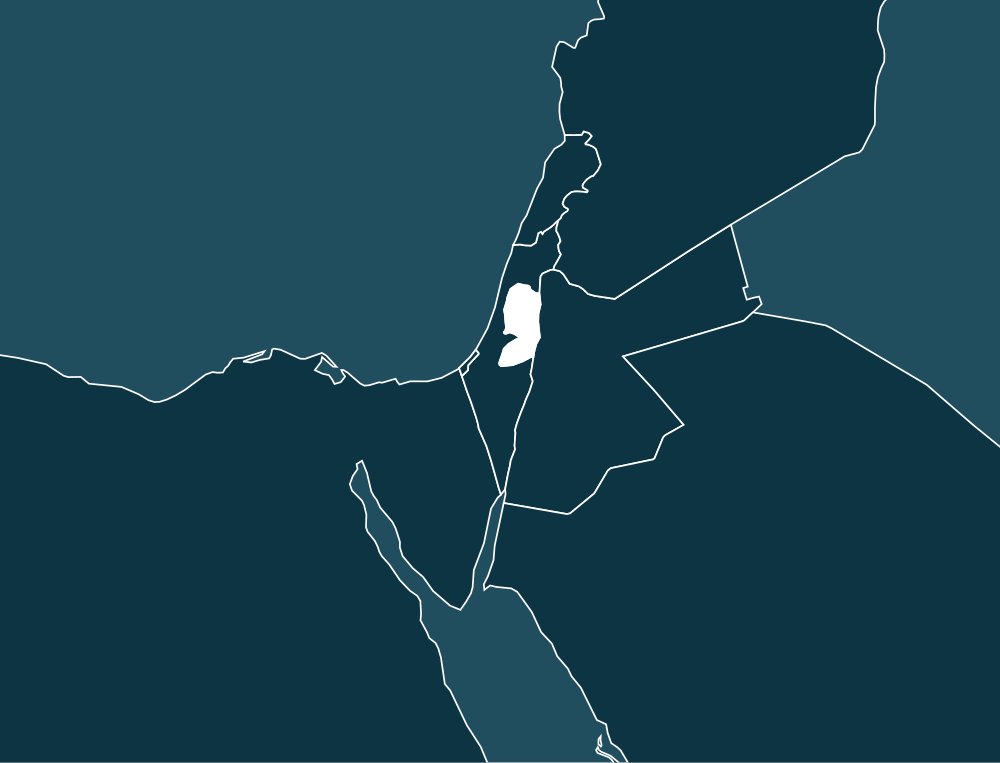
Risk Indicators
- FATF/EU Blacklist/Greylist (Medium Concern)
- Terrorism Financing (Medium Concern)
- US Dept of State INCSR
- Proliferation Financing
- Corruption
- Criminality
- Resilience & Governance
- Financial Transparency
- Offshore Finance Centres
- Sanctions
Background
The landlocked West Bank, home to roughly three million Palestinians, has been shaped by successive Ottoman, British, Jordanian, and Israeli rule since antiquity. The Oslo Accords established the Palestinian Authority and divided the territory into Areas A, B, and C, while leaving final-status questions unresolved after negotiations stalled following the 2000 uprising. Political fragmentation deepened after HAMAS’s 2006 legislative victory, the 2007 division with Fatah, and the later dissolution of the Palestinian Legislative Council by the Palestinian Constitutional Court.
The territory remains closely tied to Israel and Jordan, with Israel’s military presence, settler violence, and intensified operations contributing to persistent humanitarian and security pressures. Targeted measures by Australia, Canada, New Zealand, Norway, and the United Kingdom, alongside documented past concerns involving Israeli financial institutions and crowdfunding platforms, add a significant sanctions-compliance dimension. Jordan faces economic and political strains linked to regional instability and refugee pressures, while Egypt is relevant primarily through Gaza and the security environment in Sinai rather than as a direct neighbor.
AML & Terrorist Financing
The West Bank’s AML/CFT framework operates amid fragmented administrative control, a cash-heavy economy, widespread hawala use, and vulnerabilities linked to trade-based laundering, customs fraud, and bulk cash movement. The Palestine Monetary Authority, Financial Follow-Up Unit, and Palestine Capital Market Authority provide important institutional safeguards, yet oversight of certain non-financial sectors, beneficial ownership transparency, interagency information-sharing, and investigative capacity remains uneven. Terrorist financing is addressed through broader criminal provisions rather than dedicated legislation, while the absence of a MENAFATF mutual evaluation and limited international convention coverage leaves important questions about effectiveness and implementation.
Sanctions
The West Bank is subject to a predominantly targeted sanctions landscape focused on Israeli settlement expansion, extremist settler violence, and related human-rights violations rather than comprehensive territorial restrictions. Measures have included EU Global Human Rights Sanctions designations, Canada’s Special Economic Measures regulations, coordinated actions by the UK, Australia, Canada, New Zealand, Norway and others, and newer settlement-goods restrictions, while the United States terminated its OFAC program under revoked Executive Order 14115 in January 2025. There is no indication that the West Bank itself enforces sanctions against other nations, although overlapping authorities, settlement-based financial channels, and routes through the Jordan Valley and Hebron are identified as potential enforcement and evasion concerns.
Criminality
Corruption concerns in the West Bank center on perceived nepotism, favoritism, misuse of public funds, abuse of authority, bribery, and breaches of trust, particularly within government institutions, security services, local authorities, and service-delivery ministries. Although the Anti-Graft Law, specialized anti-graft court, and Palestinian Anti-Corruption Commission provide formal safeguards, business sources continue to describe access to power as important for success, while AMAN and civil society groups remain active in monitoring and promoting accountability.
Reports
The Palestinian Authority recorded increased trafficking investigations, prosecutions, convictions, and potential labor-trafficking victims, yet fragmented laws, limited coordination, weak identification procedures, and restricted access in Area C continue to leave significant gaps. At the same time, Israeli counterterrorism operations and clashes with Palestinian militants shaped the West Bank’s security environment, while children, workers, and displaced people remained vulnerable to exploitation, forced labor, begging, and recruitment by armed groups.
Economy & Investment Climate
The West Bank economy is navigating a severe, prolonged downturn shaped by movement restrictions, reduced labor access, fiscal pressures, and dependence on external trade, even as the Palestinian Central Bureau of Statistics points to a large contraction and persistently high unemployment. Its educated workforce, resilient SME base, developing financial system under the Palestinian Monetary Authority, and investment priorities identified by IPIEA—including ICT, agriculture, tourism, manufacturing, and renewable energy—offer areas of potential amid significant political, regulatory, and infrastructure constraints.
Cryptocurrency Regulations
West Bank’s Decree-Law No. 39 of 2022 recognizes virtual assets and places AML/CFT expectations on VASPs, including customer due diligence, record-keeping, and suspicious transaction reporting to the Palestinian Financial Follow-up Unit, yet cryptocurrency is not legal tender and no public licensing registry is evident. With the Palestinian Monetary Authority warning about virtual currencies while offering no dedicated VASP, tax, ICO, or Travel Rule framework, exchanges, token offerings, and transaction reporting appear to remain in a cautiously defined legal grey area.
Get full access
The information on this page is a brief summary. Get access to EDD country reports, all risk category scores and customisable weightings for 245 jurisdictions.