
Risk Indicators
- FATF/EU Blacklist/Greylist (Lower Concern)
- Terrorism Financing (Lower Concern)
- US Dept of State INCSR
- Proliferation Financing
- Corruption
- Criminality
- Resilience & Governance
- Financial Transparency
- Offshore Finance Centres
- Sanctions
Background
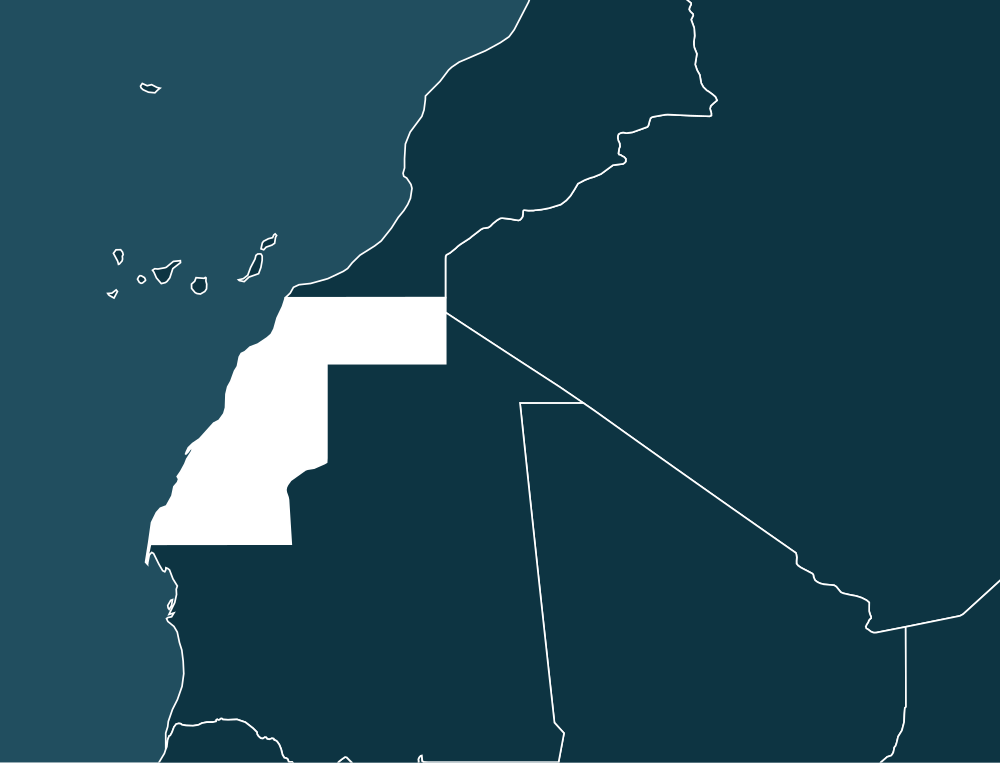
Western Sahara is a sparsely populated Atlantic territory whose desert landscape contains significant phosphate deposits, productive fishing grounds, and possible offshore oil resources. Once governed as Spanish Sahara, it became the center of competing claims after Spain’s withdrawal, Morocco’s annexation of most of the territory, and the Polisario Front’s declaration of the Sahrawi Arab Democratic Republic. The International Court of Justice’s position on Sahrawi self-determination, together with the territory’s unresolved status, continues to shape its political and legal significance.
Morocco administers most of the territory and promotes autonomy under Moroccan sovereignty, while the Polisario Front, supported by Algeria and linked to refugee camps near Tindouf, continues to call for a referendum on independence. The United Nations classifies Western Sahara as non-self-governing and has monitored a ceasefire that collapsed in 2020, even as international backing for Morocco’s autonomy proposal has expanded. Regional tensions involving Morocco, Algeria, and Mauritania—along with disputed trade, aid concerns identified by an EU anti-fraud investigation, and cross-border criminal networks—add further complexity to the question of control and recognition.
AML & Terrorist Financing
As Western Sahara is a disputed territory claimed by Morocco, its AML/CFT framework is reflected through Morocco’s evolving regime, which exited FATF increased monitoring in 2023 but remains in enhanced follow-up after the 2024 evaluation. Key concerns include cash-based activity, trafficking routes, remittances, limited beneficial-ownership access, uneven supervision, and the still-developing use of financial intelligence by bodies such as UTRF, NSJP, BAM, AMMC, and ACAPS. Terrorist-financing controls show stronger investigative capacity than proliferation-financing safeguards, while delayed targeted financial sanctions, limited NPO risk assessment, and gaps affecting legal persons leave important questions for closer examination.
Sanctions
Western Sahara, treated here through Morocco’s position, is not described as enforcing an autonomous sanctions regime against other nations, while Morocco applies binding UN Security Council measures as a UN member. Arab League sanctions relating to Syria are no longer in force, and its multi-tier Israel boycott is not applied by Morocco following the December 2020 Abraham Accords and continuing economic ties. No international sanctions are currently in force against Morocco, although reports have raised concerns about Moroccan ports, shell companies, and intermediary networks facilitating restricted Western technology and dual-use goods destined for Russia, despite measures such as the 2023 Morocco–UAE MOU.
Criminality
Western Sahara’s crime and corruption profile is closely tied to Morocco, with recurring concerns involving official corruption, trafficking and smuggling routes, illicit goods, narcotics, financial crime, and criminal networks with alleged links to political and administrative circles. Morocco’s Public Prosecutor’s Office, INPLCC, and anti-corruption hotline have pursued cases and complaints, while findings cited by the 2024 Arab Barometer indicate that corruption remains widely perceived as prevalent in state institutions.
Reports
Morocco’s regional security landscape includes shifting narcotics routes, substantial cannabis and cocaine seizures, and continued cooperation with international partners through agencies such as the Central Bureau of Judicial Investigation and the General Directorate of Territorial Surveillance. At the same time, trafficking vulnerabilities affect migrants, children, and Moroccan workers abroad, while counterterrorism efforts combine border controls, prosecutions, religious education, and prison deradicalization amid ongoing ISIS-inspired threats.
Economy & Investment Climate
Western Sahara’s economy is anchored by fishing, alongside phosphate mining and smaller contributions from agriculture and tourism, while limited rainfall and reliance on Moroccan food imports shape everyday economic life. Moroccan state control, subsidies, and price measures coexist with uncertainty over trade arrangements and the legal status of resource extraction, leaving offshore oil and gas prospects and international investment particularly sensitive.
Cryptocurrency Regulations
Western Sahara appears open to cryptocurrency activity under an emerging framework overseen by the Central Reserve Authority, with licensing, AML/CFT documentation, and FATF-aligned customer checks pointing toward regulated participation rather than a formal currency designation. Yet the territory’s unresolved political status leaves taxation, exchange supervision, token offerings, consumer protections, and mechanisms such as the Travel Rule or CARF largely uncertain, creating a landscape where future authority and international engagement may prove decisive.
Get full access
The information on this page is a brief summary. Get access to EDD country reports, all risk category scores and customisable weightings for 245 jurisdictions.