
The country AML risk platform built for regulatory scrutiny
245 jurisdictions covered.
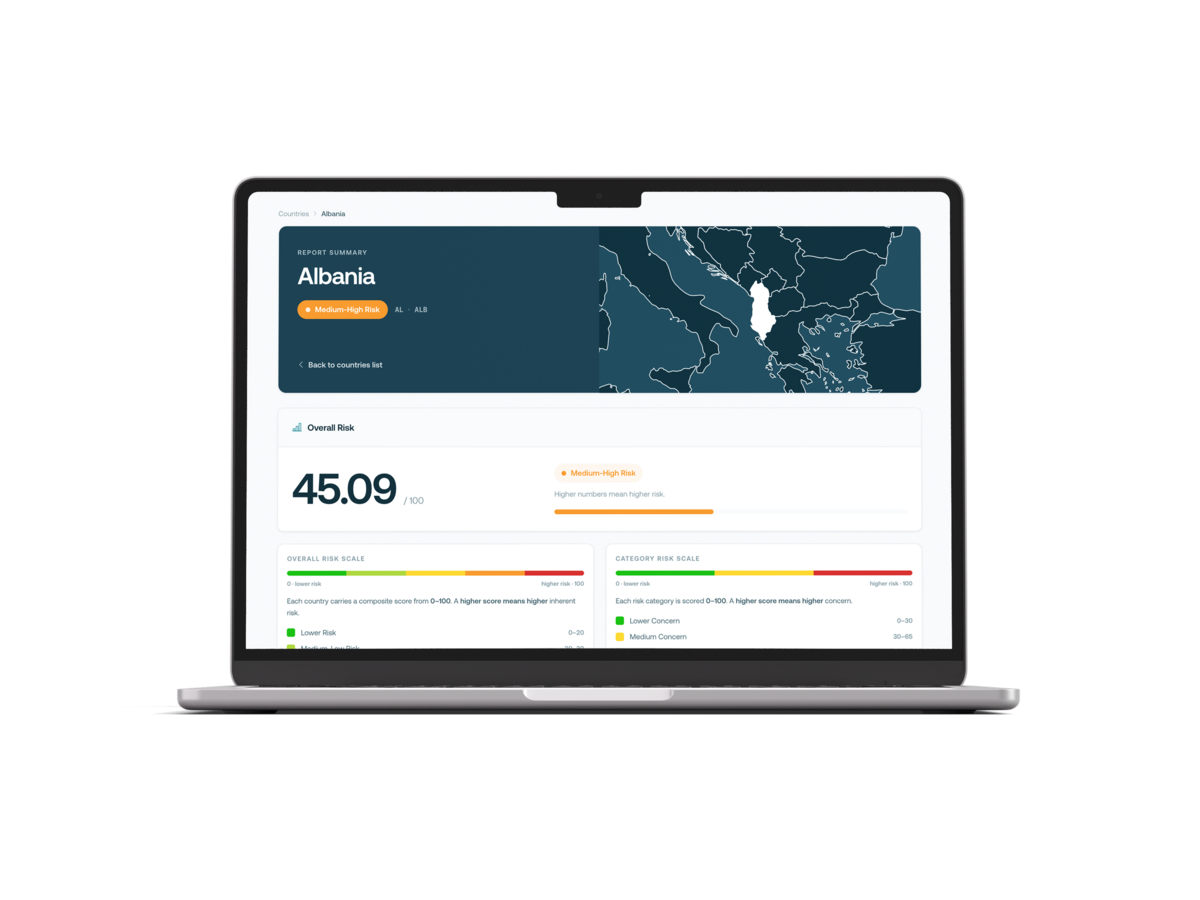
The 2026 Country AML Risk Assessment Checklist
A working checklist for compliance teams building evidence behind their country risk ratings.
A regulator reviewing your file can't tell a considered judgement from a guess unless the source, the date, and the reasoning sit right next to the rating.
This checklist covers what a defensible country AML risk assessment needs, from methodology and weighting through to the evidential trail regulators expect to see on file.
Inside, you'll find:
- The core data sources every country rating should draw on
- How to document evidence so it holds up under scrutiny
- Common gaps that show up when assessments get reviewed
- A structure you can apply to your next review cycle
245 jurisdictions.
20 years of experience.


Why regulated firms trust us
KnowYourCountry provides a comprehensive jurisdictional AML/CFT risk intelligence layer. Our platform covers 245 jurisdictions and helps regulated businesses to reinforce their AML/CFT controls with robust, transparent and defensible country risk data.
Plan Features
The KnowYourCountry website includes free report summaries for 245 countries.
Our paid plans offer three tiers of access to KnowYourCountry's jurisdictional AML risk assessments and ratings:
Professional
Everything on the website, plus:
- Unlimited access to 245 country reports and ratings
- Updated on an event basis with notifications
- Risk override function and timestamps
- Industry risk reporting, covering AML, CFT, corruption and sanctions across 47 sectors
Professional Plus
Everything in Professional, as well as:
- Downloadable dataset, customisable to your organisation's risk appetite, geography and business model
- FATF Mutual Evaluation Recs Assessments
- Virtual asset/VASP risk matrix, scoring and reporting
Enterprise
Everything in Professional Plus, as well as:
- Full API access: integrate KnowYourCountry data into your onboarding platforms and KYC systems
- Customisable Scoring Profiles: a centralised, fully configurable framework with custom bands, weightings and overrides
- Up to 100 users across multiple jurisdictions
“Without this resource, assessing a country's risk would be much more time-consuming and we've previously often found it difficult to locate the relevant documents needed”.
“The level of detail and accuracy in the country reports is impressive. The tool has significantly enhanced my ability to assess AML risks and make informed decisions.”
“The QFCRA has been a regular user of KnowYourCountry and has found it to be a highly beneficial product from a regulator’s perspective. Its insights support our AML/CFT risk assessment processes...and help strengthen a more informed, consistent and risk-based supervisory approach.”
"We've been using KnowYourCountry for several years, and it has become an essential part of how we assess risks across our client portfolio. All come in one place: country risk ratings, sanctions updates and other shifts in geo risks. Updates arrive on time, so we are barely caught off guard by a change. The service's foundational methodology gives us a well-rounded view of each country, which is exactly what we need."
FAQs
How is KnowYourCountry different from doing your own research?
Building your own country risk methodology is a significant internal project. Source selection, weighting, documentation, and ongoing maintenance every time there is a change across every jurisdiction you cover is a continuous operational commitment.When a regulator asks how you arrived at a rating, that answer has to be defensible.
KnowYourCountry gives compliance teams a verified, auditable methodology with a human name attached. Every AI-assisted element is reviewed and approved by subject-matter experts before publication. The scoring is entirely human-overseen. When you use KnowYourCountry, the methodology, source selection and update obligations are ours. You apply the output.
What types of organisations use KnowYourCountry?
Any regulated business with AML obligations. That includes banks, investment firms, money service businesses, insurers, auditors, accountants, tax advisers, trust and company service providers, crypto asset exchanges, custodial wallet providers, estate agents, legal professionals, and art market participants. Broadly, any organisation required to assess customer and counterparty risk on a risk-based approach.
How is the methodology documented for regulators and auditors?
Every rating links back to its primary source. Scoring weightings and any overrides are time-stamped and logged. If a regulator asks what sits behind a country rating, the platform produces a complete, source-referenced audit trail.
Can we apply our own risk appetite rather than a default score?
Yes. Scoring Profiles let you adjust the weighting of each underlying indicator, set your own risk bands, input country-specific overrides, and build separate configurations for different business lines, offices, or use cases. Every profile updates automatically when the underlying data changes.