
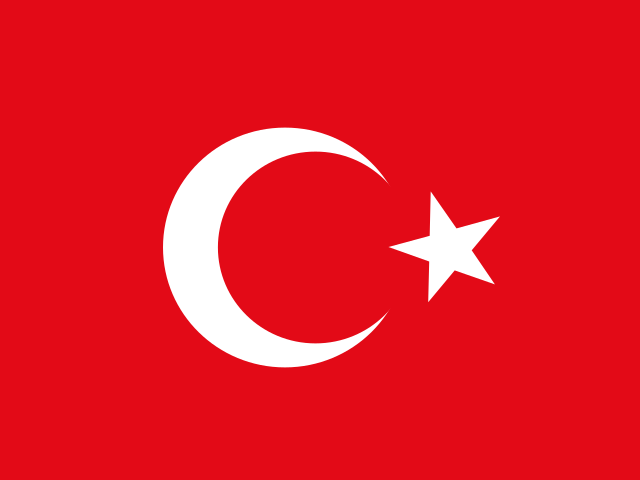
Turkey Country Summary
Medium-High Risk
View full Ratings TableSanctions
Medium Concern
FATF AML Deficient List
Lower Concern
Terrorism
Medium Concern
Corruption
Higher Concern
US State ML Assessment
Higher Concern
Criminal Markets (GI Index)
Higher Concern
EU Tax Blacklist
Medium Concern
Offshore Finance Center
Lower Concern
Please note that although the below Summary will give a general outline of the AML risks associated with the jurisdiction, if you are a Regulated entity then you may need to demonstrate that your Jurisdictional AML risk assessment has included a full assessment of the risk elements that have been identified as underpinning overall Country AML risk. To satisfy these requirements, we would recommend that you use our Subscription area.
If you would like a demo of our Subscription area, please reserve a day/time that suits you best using this link, or you may Contact Us for further information.
Anti Money Laundering
FATF Status
Turkey is no longer on the FATF List of Countries that have been identified as having strategic AML deficiencies
Compliance with FATF Recommendations
The last follow-up Mutual Evaluation Report relating to the implementation of anti-money laundering and counter-terrorist financing standards in Turkey was undertaken in 2023. According to that Evaluation, Turkey was deemed Compliant for 14 and Largely Compliant for 25 of the FATF 40 Recommendations. It remains Highly Effective for 0 and Substantially Effective for 2 with regard to the 11 areas of Effectiveness of its AML/CFT Regime.
Sanctions
UN sanctions currently do not target Turkey, but several major jurisdictions have enforced targeted sanctions against Turkey, including the United States with Syria-related blocking sanctions on the Ministry of National Defense and Ministry of Energy, asset freezes and visa bans on senior officials, and CAATSA restrictions on the Presidency of Defense Industries for purchasing Russian S-400 systems. The European Union and United Kingdom have imposed additional targeted measures such as asset freezes and travel bans tied to unauthorized drilling in Cypriot waters (EU extension to 2025; UK measures mirroring EU actions), while Canada maintained a temporary arms embargo that was lifted in January 2024, and other European non-EU states implemented national arms embargoes after the 2019 Syria operation that have largely been lifted.
Criminality
Rating |
0 (bad) - 100 (good) |
|---|---|
| Transparency International Corruption Index | 31 |
| World Bank: Control of Corruption Percentile Rank | 35 |
Turkey faces significant challenges related to crime and corruption, with pervasive issues such as human trafficking, arms trafficking, and financial crimes. Despite efforts to enhance transparency through public procurement reforms and participation in anti-corruption initiatives, allegations of favoritism and uneven enforcement of anti-bribery laws persist, undermining the effectiveness of these measures.
Economy
In 2024, Turkey's economy experienced a GDP growth of 3.2%, a decline from the previous year's 5.1%, while inflation surged to an average of 60%, driven by strong demand and high food and service prices. The Turkish lira depreciated significantly, losing 20% of its value against the dollar, prompting the Central Bank to raise interest rates sharply in response to economic instability and investor concerns. Despite these challenges, Turkey's investment climate remains attractive due to its strategic location, large domestic market, and favorable demographics, although risks persist from structural weaknesses, high current account deficits, and geopolitical tensions.
Subscribe to
Professional Plus
- Unlimited Access to full Risk Reports
- Full Dataset Download
- API Access
- Virtual Asset Risk Assessments
