
Risk Indicators
- FATF/EU Blacklist/Greylist (Lower Concern)
- Terrorism Financing (Lower Concern)
- US Dept of State INCSR
- Proliferation Financing
- Corruption
- Criminality
- Resilience & Governance
- Financial Transparency
- Offshore Finance Centres
- Sanctions
Background
Turkmenistan’s history reflects its position at a crossroads of empires, from Persian rule and the Silk Road city of Merv to Russian annexation, Soviet statehood, and independence in 1991. Its modern political landscape has been shaped by the succession from Saparmurat NIYAZOV to Gurbanguly BERDIMUHAMEDOV and then Serdar BERDIMUHAMEDOV, while the Halk Maslahaty preserves the former president’s influence. State-controlled terminology surrounding “Hero-Arkadag” and “Arkadagly Serdar” offers a glimpse into the country’s distinctive political culture.
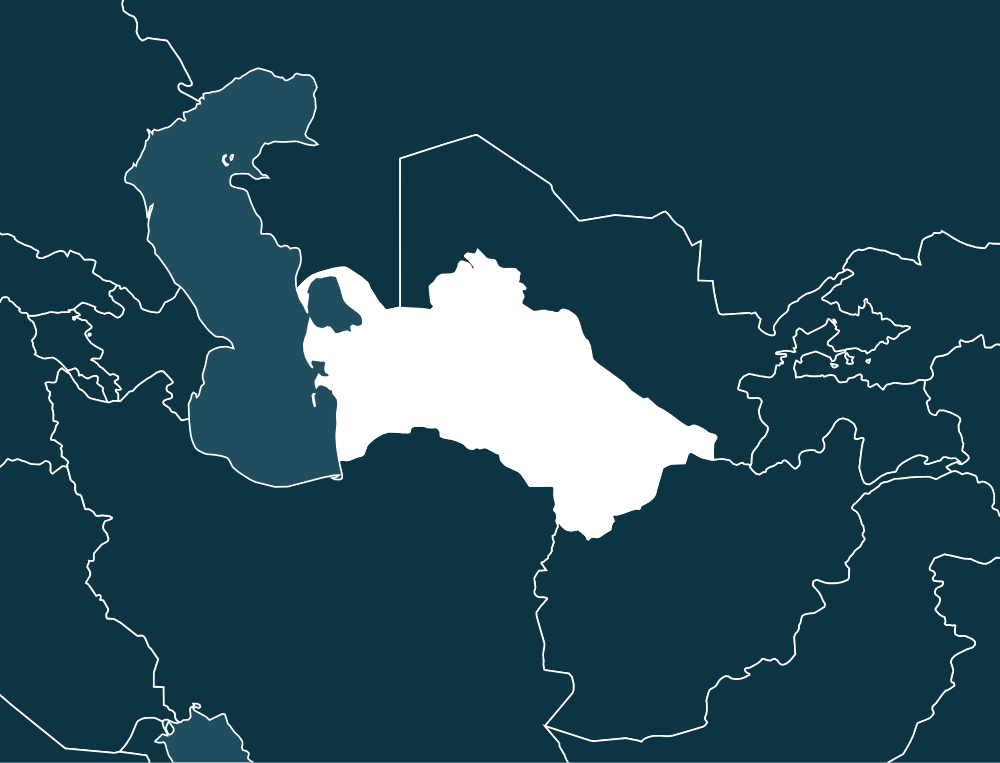
The country’s extensive but incompletely exploited natural-gas reserves remain central to its economic outlook, even as dependence on energy exports has exposed citizens to hardship and encouraged emigration, particularly to Turkey. Turkmenistan also faces a complex neighborhood shaped by the Taliban and ISKP presence along its 744-kilometer Afghan border, sanctions affecting trade with Iran, and monitored Russia-linked supply routes through Uzbekistan and Kazakhstan. Against this backdrop, it presents itself as a neutral transport hub while balancing regional insecurity, cross-border trafficking risks, and international sanctions pressures.
AML & Terrorist Financing
Turkmenistan has strengthened its AML/CFT framework and is no longer subject to FATF monitoring, yet it remains under enhanced EAG follow-up through November 2027, with uneven compliance and effectiveness across the FATF Recommendations. The Financial Monitoring Service (FMS), law enforcement agencies, and the Central Bank have developed mechanisms for intelligence-sharing, risk assessment, and preventive action, but concerns persist around the quality of suspicious transaction reports, investigative access, beneficial ownership verification, transparency, and offshore wealth. Terrorist-financing risk is assessed as low with no recorded terrorist-financing cases, although limitations in timely targeted-financial-sanctions implementation, information access, new-technology risk analysis, and proliferation-financing controls leave important areas for further attention.
Sanctions
Turkmenistan is required, as a UN member, to implement Security Council measures, yet no international sanctions are currently in force against the country. The material identifies no distinct sanctions imposed by Turkmenistan on other nations, while raising concerns that Turkmenbashi Port, rail links, and corridors such as the Middle Corridor may facilitate the rerouting of restricted energy, technology, and other goods—particularly toward Russia and, indirectly, Belarus. U.S.-flagged transshipment concerns, possible gas rebranding, and opaque state-linked financial channels point to potential exposure to secondary sanctions despite Turkmenistan’s stated neutrality.
Criminality
Corruption is described as widespread and entrenched across Turkmenistan, particularly in procurement, licensing, customs, education, healthcare, and traffic enforcement, with responsibilities divided among the Ministry of Internal Affairs, Ministry of National Security, and General Prosecutor’s Office but no independent watchdog or publicized official prosecutions in 2024. Criminal activity includes forced labor and sex trafficking, heroin transit, counterfeit goods, illegal wildlife trade, banking fraud, embezzlement, and tax evasion, with state-embedded actors and officials frequently linked to the country’s illicit markets.
Reports
Turkmenistan remains a strategic transit point for Afghan opiates and is strengthening border, forensic, and counterterrorism capabilities through cooperation involving the Ministry of Internal Affairs, Ministry of Health, UNODC, and international partners, despite limited transparency and concerns about outdated operational practices. The country also faces persistent human-trafficking risks linked to cotton harvesting and other compelled labor, with recent steps including a new anti-trafficking commission and national action plan alongside continued vulnerabilities affecting workers, children, and citizens abroad.
Industry/Product Sector Risk
Turkmenistan’s financial and commercial landscape is highly state-dominated, with banks, the State Commodity and Raw Materials Exchange, and tightly controlled currency channels central to domestic and cross-border activity. The most significant exposure is associated with real estate, retail banking, trade finance, cash-intensive activity, politics, public works and construction, and transportation, where corruption, mispricing, smuggling, tax offences and opaque ownership structures may intersect. Although notaries and state real estate registrars provide extensive transaction information to the FIU, vulnerabilities remain in beneficial-ownership verification, complex transaction monitoring, and the use of foreign companies, intermediaries and cash to conceal illicit proceeds.
Economy & Investment Climate
Turkmenistan’s economy remains dominated by state-owned enterprises and hydrocarbon exports, particularly natural gas sales to China, while agriculture, textiles, petrochemicals, and services offer potential for diversification. Despite stated interest in foreign investment and initiatives such as the State Commodity and Raw Materials Exchange registration system and the 2024 trade “single window,” severe currency restrictions, opaque administration, limited financing, and weak regulatory enforcement continue to constrain commercial activity.
Cryptocurrency Regulations
Turkmenistan’s Law on Virtual Assets, effective January 1, 2026, brings cryptocurrencies into a newly regulated space as civil property rather than legal tender, with licensing and oversight centralized under the Central Bank of Turkmenistan. Exchanges, miners, and token issuers face registration, KYC/AML, disclosure, and risk-warning requirements, although the FATF’s earlier findings and the limited public detail on taxation, Travel Rule obligations, and practical supervision suggest that implementation is still taking shape.
Get full access
The information on this page is a brief summary. Get access to EDD country reports, all risk category scores and customisable weightings for 245 jurisdictions.