
Free webinar: Diverging sanctions regimes, 30 September 12pm (BST)
September 15, 2026
- Webinars
Diverging Sanctions Regimes: How to Navigate Divergent Sanctions by the US, EU and the UK
Sanctions are becoming increasingly divergent across jurisdictions.
While the US, EU and UK often coordinate on major foreign-policy objectives, they do not always impose the same sanctions, target the same entities, or apply the same restrictions.
For global companies, this creates a growing challenge: how do you build a sanctions compliance framework when the answer can depend on where your business, customer, vessel, transaction or employee is located?
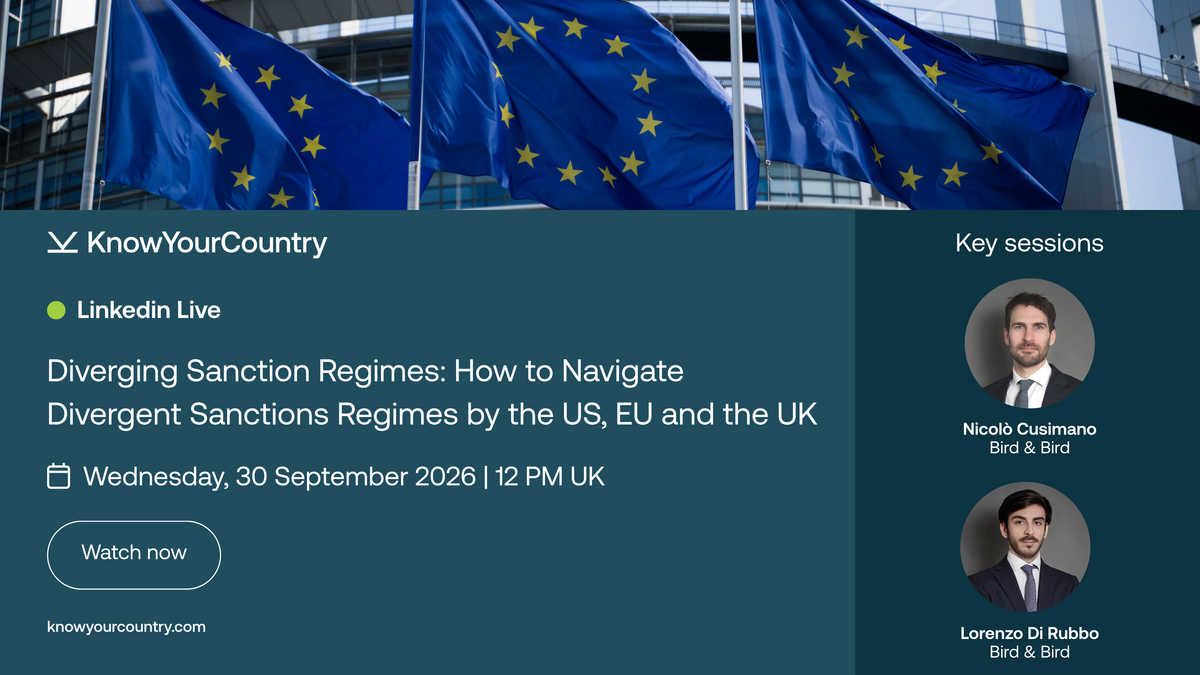
Join Know Your Country for a LinkedIn Live discussion with Nicolò Cusimano and Lorenzo Di Rubbo of Bird & Bird as we explore some of the most important areas of divergence between the US, EU and UK sanctions regimes.
We will look at practical examples, including:
- Russian vessels: The EU and UK have dramatically expanded their sanctions against Russia's shadow fleet. As of July 2026, the EU had sanctioned 671 vessels and the UK 621, compared with no new US shadow-fleet vessel designations since the end of the Biden administration.
- Cuba: US sanctions remain substantially more extensive than the EU and UK approach, creating particularly challenging questions for multinational companies operating across the Atlantic. Recent US measures have further increased this divergence.
- Belarus: The EU, UK and US have developed different combinations of asset freezes, trade restrictions, transport measures and sectoral sanctions, meaning that a transaction permissible in one jurisdiction may be restricted in another.
- Different licensing, exemptions and enforcement approaches — and why these differences matter for global businesses.
- The practical compliance challenge: Should companies apply the strictest regime globally, or operate jurisdiction-specific controls?
- Global screening and transaction controls: How can compliance teams identify which sanctions regime applies to a particular customer, transaction, vessel or supply chain?
- Managing conflicts between jurisdictions: What should companies do when complying with one jurisdiction's sanctions requirements creates difficulties under another jurisdiction's rules?
The discussion will focus not only on what the differences are, but on how global trade compliance organisations can manage them in practice.
Watch the recording
Subscribe to Country AML Risk News
Don’t want to miss an issue? Get this newsletter delivered straight to your inbox.